
by Andrea Champion
Building Healthier Communities
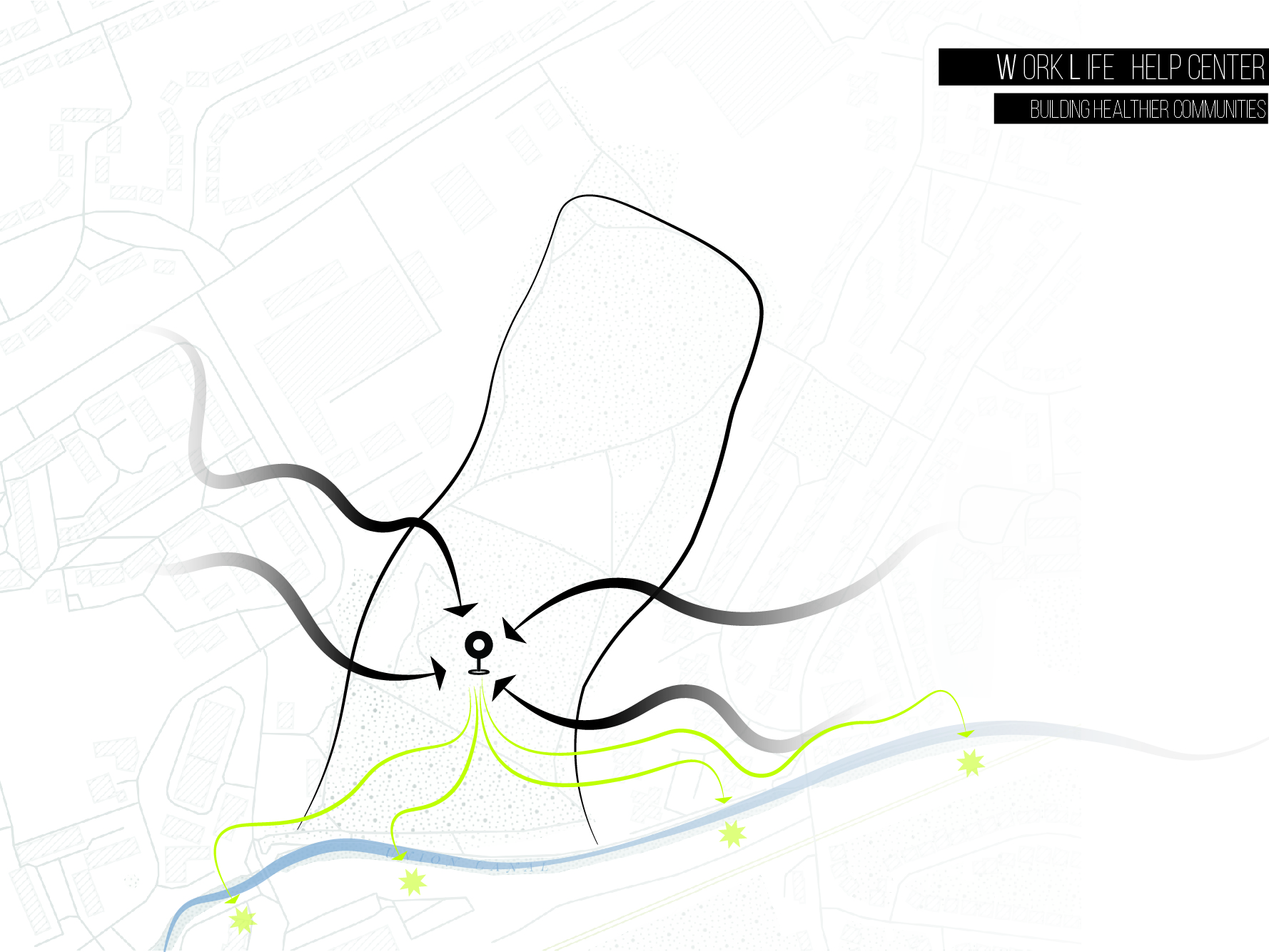
The WorkLife Help center seeks to specifically help the communities of Wester Hailes and Longstone, these communities show high levels of social exclusion (particularly Wester Hailes), from the main city and the canal, this is in part because they are far away from the city’s services and amenities, as a consequence of being farther from the city they mostly rely on the bus network to move around- walking or cycling to work via the canal is usually not an option, it would take too much time and effort. Wester Hailes is also known for having problems with drugs and alcohol abuse and on top of that good quantity of them hold only a part time job or are unemployed, also their education level is lower than average which makes it more difficult to land a job that they would like to have.
Because the two communities are far from the cities attentions and amenities, and there is no sense of ownership or pride towards the canal. They are both similar in their demographics but socially one could say that Wester Hails has a much worse reputation even though Longstone is not far behind. Creating a center that offers solutions to the communities needs as well as connecting them with each other encourages social engagement and fosters change to transform them into healthier communities. The main goal is to also reconnect them with the canal, so they can feel that they’re part of it, this will be mainly through job assessment and training relevant to canal growth and maintenance, activities such as : Vegetation management, canal engineering, archival and field survey work between many other opportunities.
The center will be developed on Hailes Quarry Park, being that initially it was developed for the people of Wester Hailes with the specific focus for events and activities in the surrounding communities, it was also designed to be a multi-functional and welcoming park, well used and valued by local people. Essentially the park was developed because it’s link to the Union Canal was meant to produce a truly special place. The Park had many plans that were not able to be fulfilled because of lack of funding, so integrating the WorkLife Help Center to this area in particular enriches the Wester Hailes peoples patrimony as well as Longstone’s.
To be able to develop the project successfully studies must be done a different scales, for example at a larger scale I will be looking into the Wester Hailes and Longstone neighborhoods- understanding the actual physical output of people that will actual need to use the Help Center, this will be essential because it will determine the size of the project or wether it will be only one building or a group of buildings. Understanding the actual physical connections that they have to Hailes Quarry Park , to analyze where more strategic paths could be opened up to connect the communities to the project and henceforth to the canal more succesfully. Zooming in a bit, depending on the very specific place where the project will be placed within the site, some landscaping might be taken into consideration to “bridge” those gaps between the center and the canal thus creating a more homogenous project. The design in itself will look to be as energy efficient as possible, which will be defined once the site analysis is done with the respective sun and wind analysis, potential for using the canal water as a cooling tool for the building as well as PV panel and other energy efficient tools.
As a final result I would like to have a center which does not impose on the respective communities or site, rather a project that will act as a tool for progress and better community building, enriching and making the canal grow at the same time. I truly believe that when you take on a project that involves whole communities you must design for them first and see how they guide towards building something tangible. The project will look to bring back a balance between canal and communities.
Cyclist and Pedestrian flows
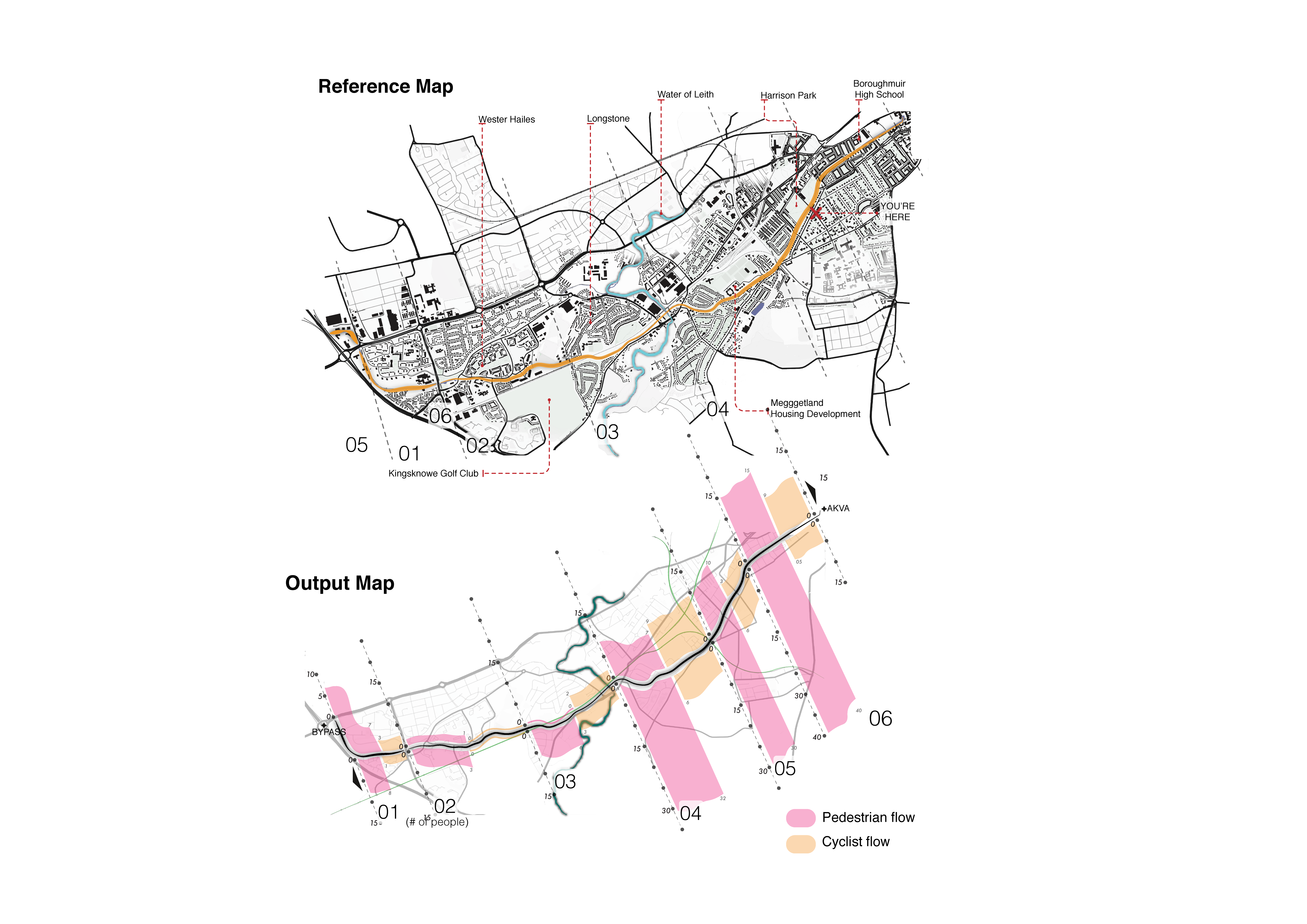
Problems on the towpath between cyclist and pedestrian were one of the initial observations from the site analysis, the towpath is narrow and nothing has been done to remediate the problem. Cyclists think they ‘own’ the path so they disregard the pedestrians and endanger them when they pass them at high velocities. Initial analysis of the area was focused on this specific flow. Conflict aside, I was interested in the density of use depending on the community demographic. this would eventually lead me to the conclusion that the areas near the canal that were the least uses were that of Wester Hailes and Longstone. After personal research and talks with the community members, I learnt that a percentage of these communities struggle with securing a job because of past crime history, which makes it harder for them to land a job. Because of the higher rates of vandalism, the area of the canal that passes though these neighborhoods is littered and uncared for, which encourages the locals to neglect it even more.
Chosen site: Hailes Quarry Park
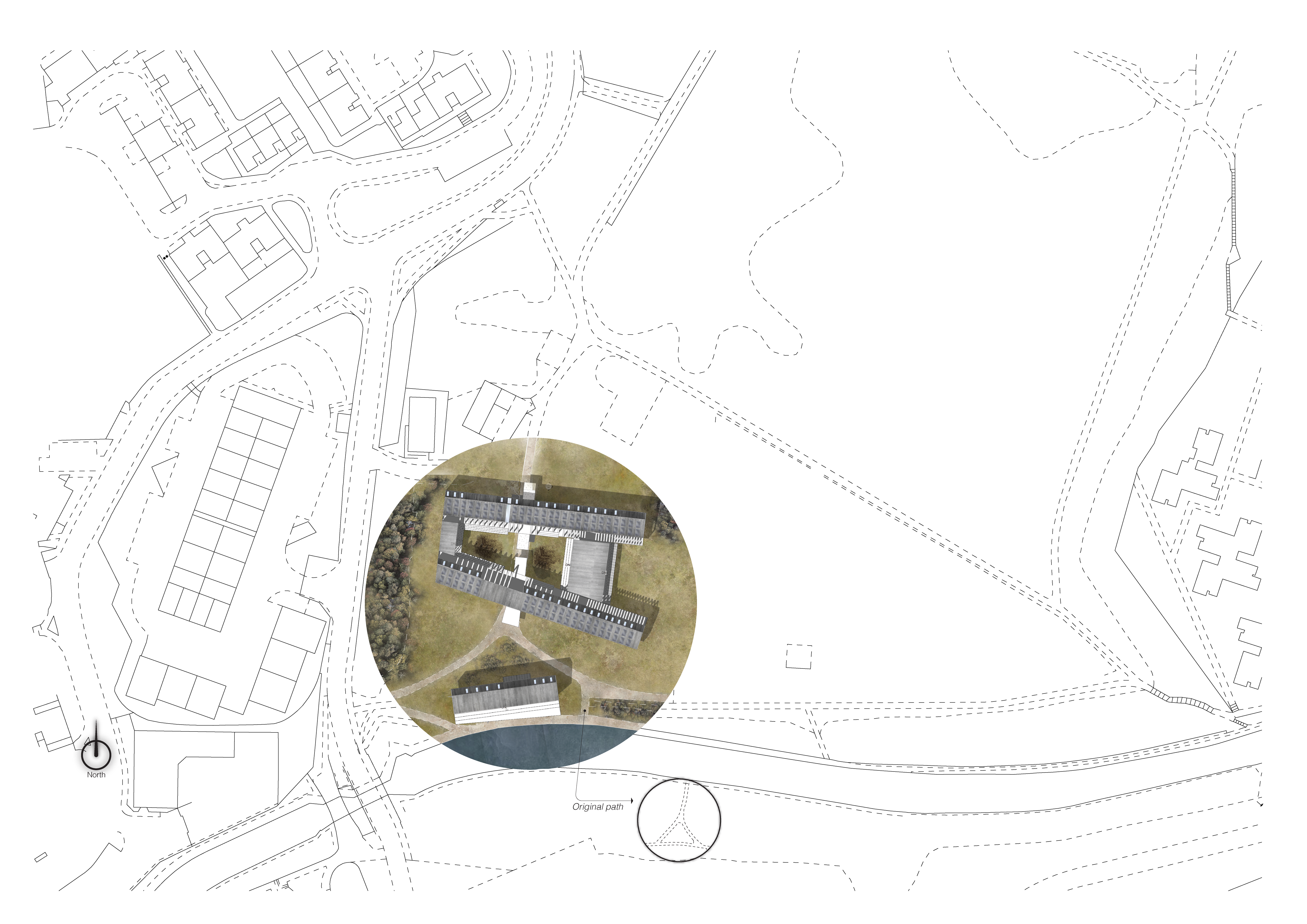
The WorkLife Help Center seeks to reconnect the neighboring communities of Wester Hailes and Longstone to the Union Canal. The objective will be to not only to benefit the surrounding communities with the project’s outputs, but also revitalize the canal through the communities participation. The canal was built more than 100 years ago, and through those years it has gone through many transitions , something that has remained a constant however and specifically to these two communities, is the lack of sense of ownership that they feel towards the canal, since both of them are far away from the city center, instead of using the canal as a transportation route, they normally use the bus to get to where they want to go; walking or cycling on a daily basis through the canal’s towpath would take too much time and effort. This unfortunately leaves the canal unused and ignored, as a consequence the part of the canal that passes by these areas has a litter problem and in some parts a vandalism problem.
Creating a center that offers solutions to the communities’ needs as well as connecting them with each other encourages social engagement and fosters change to transform them into healthier communities; the project not only looks to make these communities healthier through social engagement and cooperation but also revitalizing the canal through job assessment and training relevant to the growth and maintenance of the canal such as: Vegetation management, canal engineering, archival and field survey work, also offering a variety of workshops with metal and wood. It could basically be understood as the incoming input being the community members from Wester Hailes and Longstone and the output being the activities that revitalize Union Canal through the centers training and learning programs.
The chosen site for the centre was Hailes Quarry Park, it’s not only strategically beneficial for the centre, because it stands between the two communities, but It was initially developed to be a multi-functional and welcoming park to be used by the local people- the park was essentially developed because of it’s link to the canal was meant to create a special place. The park had many plans that were not able to be fulfilled because of lack of funding, so integrating the WorkLife Help Center to this area in particular aims to enrich and compliment the Wester Hailes peoples patrimony as well as Longstone’s.
How do the locals actually reach the center?
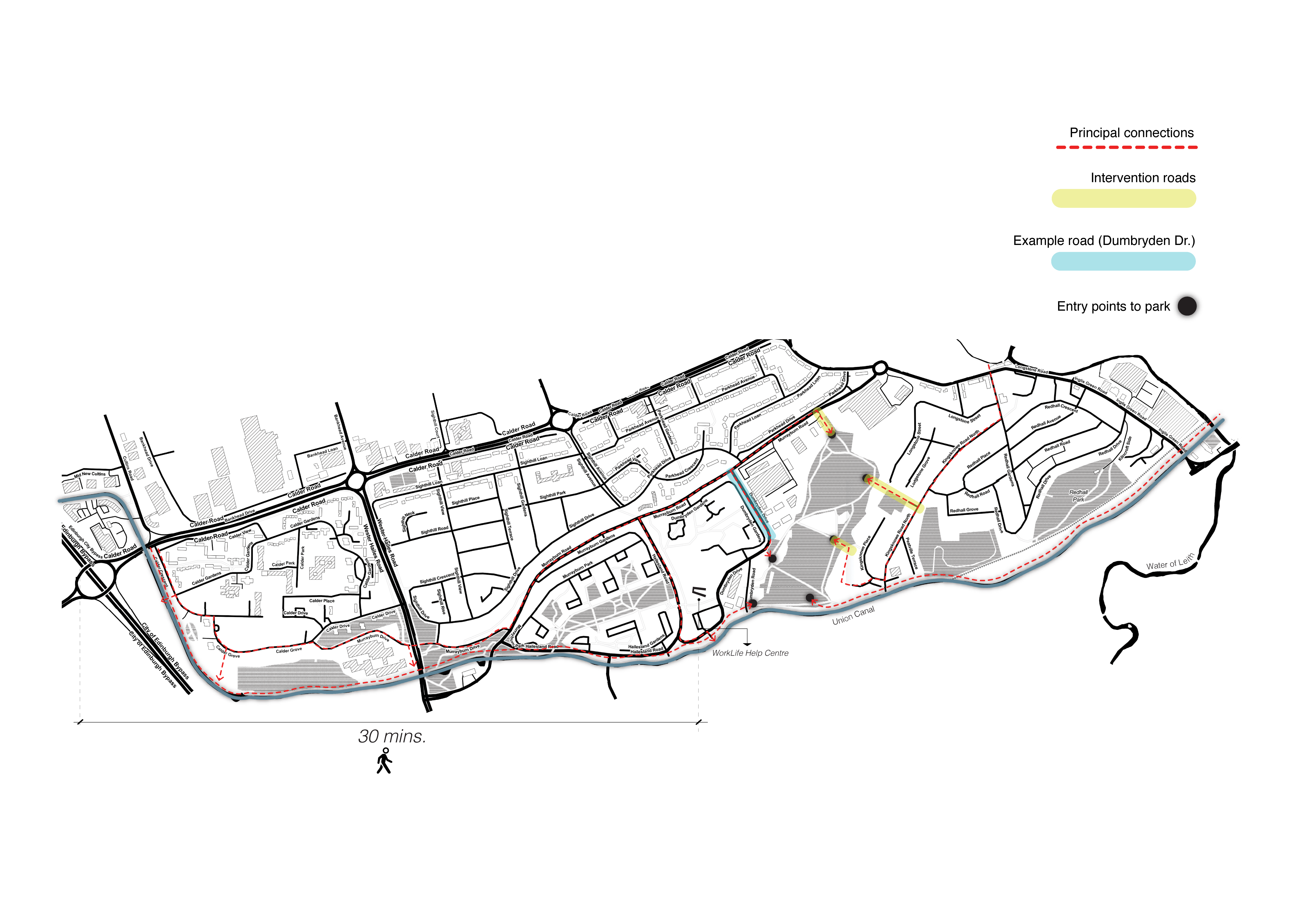
Analyzing the site more closely was required to understand how both communities would actually reach the site and ultimately the center. The canal points to the most obvious and direct route, but as it was mentioned before not many people use it- this is why the towpath couldn’t be the only route that the centre could rely on to ‘pull’ people in. Starting at the smaller scale, the park only has four entrances (excluding both entrances from either side of the canal through the towpath), that is very few access points and some of the roads might be harder to get through because of higher traffic streets that make it harder for pedestrians and cyclists to reach the endpoint.
Zooming out to the neighborhood scale the potential ‘arteries’ that feed into the canal or directly to the park are marked in red, the quickest route for the farthest point from the site would actually have to be the towpath since it’s trickier to get through all the streets and obstacles, fortunately this is only a thirty minute walk and very manageable. Street regeneration was chosen for the four entry points to the park, this looks to ‘enliven’ the roads, equipping them with more generous sidewalks, more green areas and urban furniture to interact with, encouraging people engage more with the streets and essentially acting as magnet points that ‘pull’ people into the park and henceforth to the center.
Integrative Regeneration
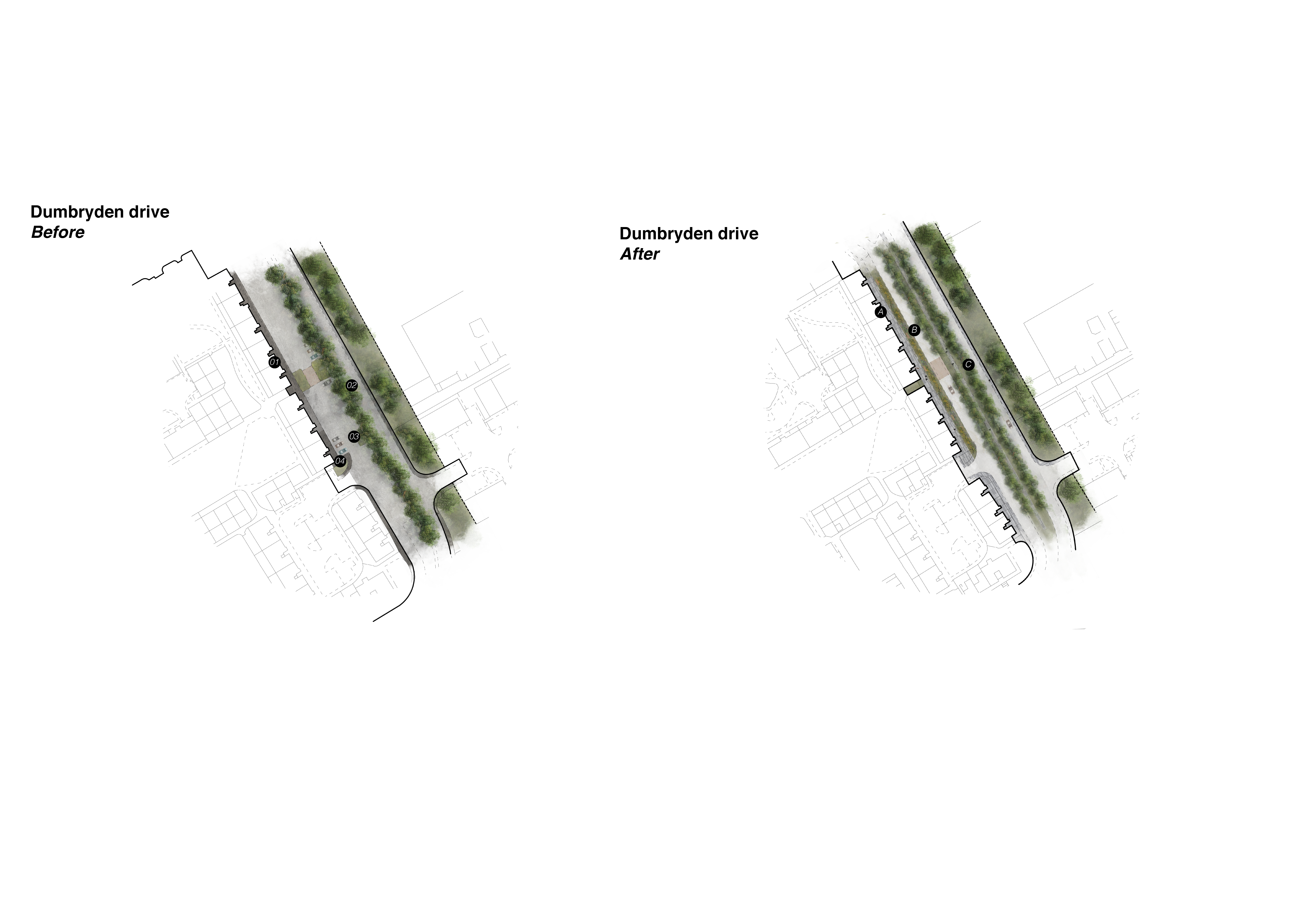
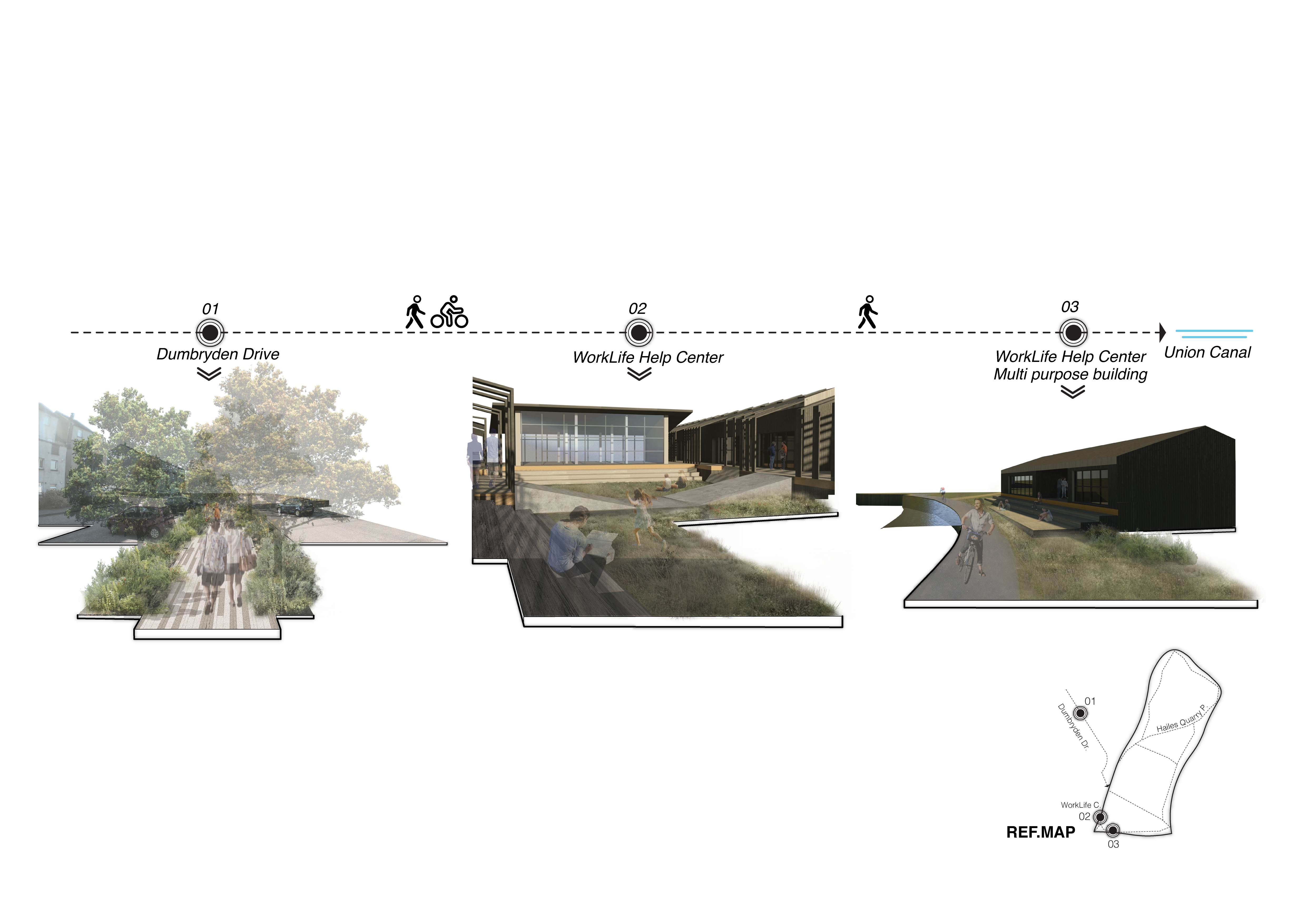
The project is not just about producing a center, it’s about an integrative means of regenerating an area, it focuses on looking at all the different scales that the project will ultimately affect, the neighborhood, which is the user- how the user is transported or moved , which is the street and the hub which works as the effective center that will eventually push for the desired output of the project.
Dumbryden drive was taken as a prototype example of the interventions that would also be applied in the other four streets. In this particular case, the street seemed inactive, only serving as a transition point and not a relax or rest point. For starters the sidewalks are very narrow and have no green area or vegetation to ‘interact’ with (01), it also doesn’t help that the facades are not very well kept and do not inspire people to walk through there- the main divider of the street seems to be a green corridor and although it does offer biodiversity, it doesn’t encourage people to interact with it because there is no walkable area running through it (02). The green patches of vegetation only serve as physical barrier for car park (03) as well as the wasted space that the cars take when they could be moved somewhere else in the vicinity and instead use that area for something that will motivate both cyclists and pedestrians to pass through that area of the street (04).
The first move for the regeneration proposal was to widen the sidewalks (A), in the ‘before’ diagram the sidewalks measure about two meters, in the ‘after’ the sidewalk is widened to eight , this gives more than plenty of space for both cyclist and pedestrian. The second move was to add biodiversity and urban furniture to the sidewalk, making a more pleasant place either to walk or rest (B). Lastly the central corridor was given walkable area between two rows of trees and bushes, acting as a buffer zone from the incoming traffic (C).
Form Finding
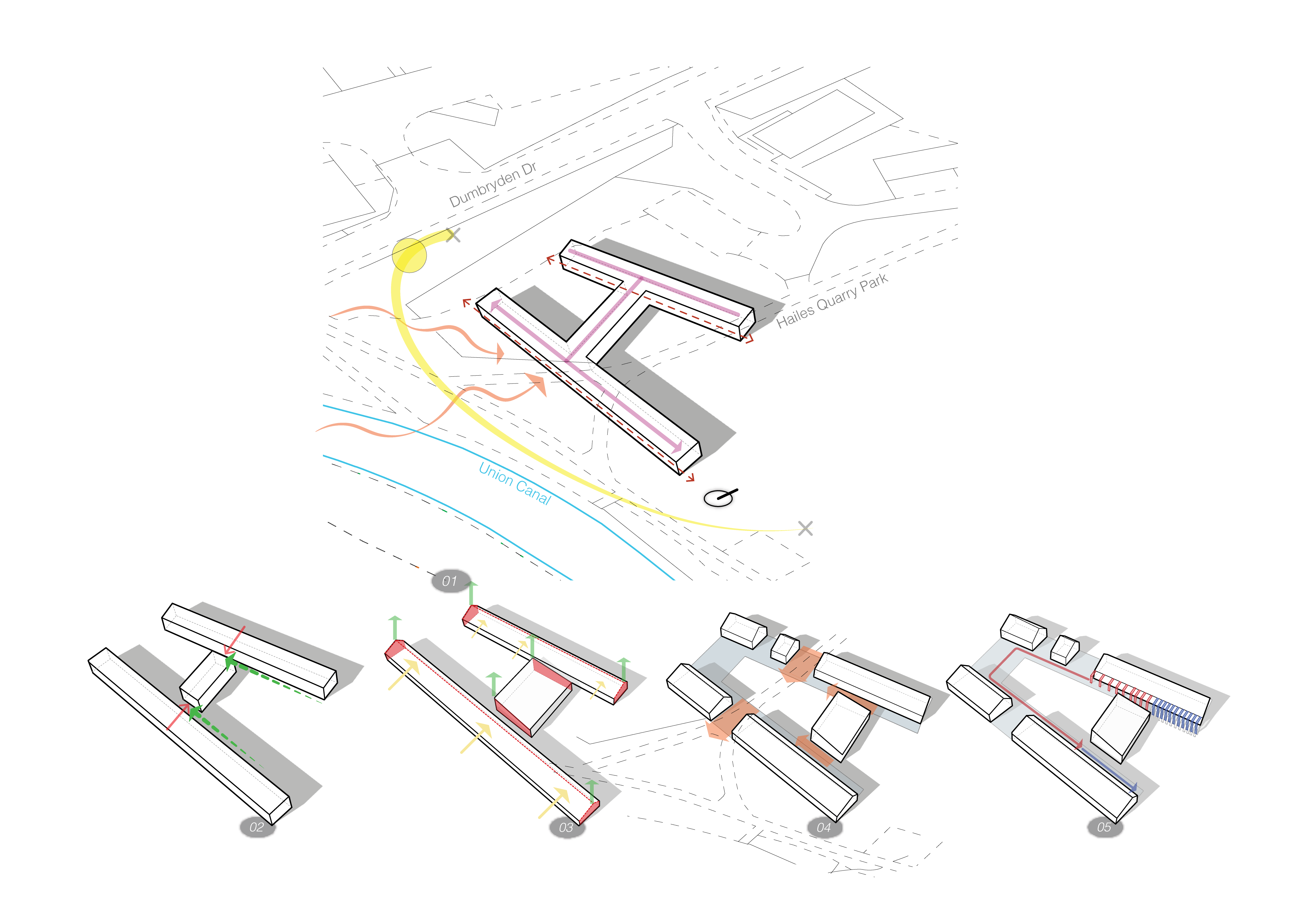
01 The building design started with two long axes that go from east to west, the long facade protects the inner courtyard from the predominant south-southwest winds, this also allows the longer facades to get the warmer southern sun, mainly for thermal mass gains. The building design aimed for a connected flow of the spaces, hence the initial ‘H’ floor plan.
02 The initial perpendicular volume was disconnected, this allows the users of the park to enjoy the inner courtyards of the building freely.
03 A double pitched roof was created fo the lateral volumes, the eaves on the southern side were purposely designed to be wider so that maximum PV panel input could be taken advantage of.
04 Programmatically the floor plan evolves and entry ways are created in the lateral buildings, this gives an uninterrupted flow for cyclists and pedestrians, as well as representing an inviting gesture to come and enjoy the spaces in the center
05 The ‘frame’ becomes an extension of the roof and lands on the elevated platforms, this aids in protecting the eaveless volumes from excess solar gain. The blue represents a more saturated pattern for the frame which gives more privacy to the more exposed parts of the building; as the flow goes inward (red), the frames disperse and allows to direct flow directly from space to courtyard
Adaptability
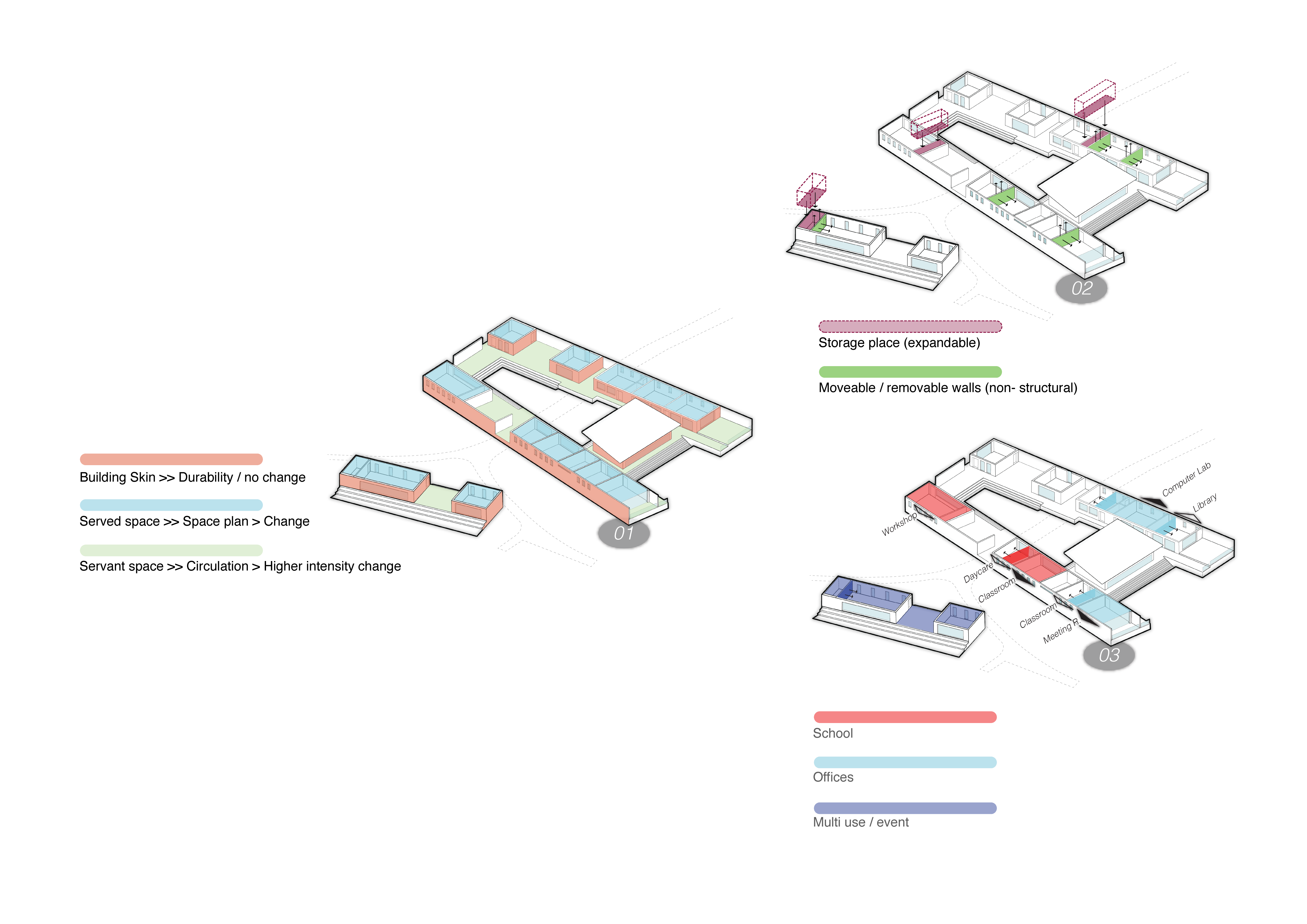
Thinking of an adaptable future for the building is the key to it’s survival, a building that cannot adapt or change is doomed to fail and ultimately be left unused or demolished. Adaptability is the capability of molding to different social uses and having a flexible building plan for example allows for more adaptable space use, thus prolonging the buildings life cycle and making it more environmentally friendly. A building must also have ‘flexibility’, the capability of flexible arrangements.
The WorkLIfe Center’s objective is to be as sustainable as possible, not only environmentally but also socially- providing spaces that can change overtime according to the communities needs is key to it’s success. Instead of being a building that self imposes and assumes what the user wants , it’s flexibility and adaptability show that the space is allowed to be tampered with and manipulated by the user- imposing itself as an ‘incomplete’ building gives the idea that the project was designed according to the things that the users will want in the future instead of designing for an assumed present.
01 The basic elements that put the the building together also define weather change will be more permanent or in a higher frequency. The projects rectangular south and north wings offer a more regular space plan since all the edges are orthogonal and offer expansion (building skin). The project was built around the idea the their would be a strong connection to the courtyards, this gives a larger space for circulation (servant space).
02 Thanks to de buildings overall ‘framed’ design and short span, there are no intermediate columns, which gives the opportunity to remove central walls if the space be needed- storage can also be expanded on either side if needed.
03 Adaptability to different spacial uses is essential, since communities are always evolving and growing. In the case of the building becoming solely and educational center places like the workshop could be re-fitted and used to accommodate classroom requirements- the same goes for the classroom on the top left, which could easily expand and take over what was once the daycare. Same rules apply to an office- expanding the computer lab to accommodate more computers as well as expanding the storage for an IT room. The extra building offers a regular space plan that could adapt to many functions ranging from storage in the summer for boats or kayaks, seminars, parties a temporary workspace etc.
Architectural Plan
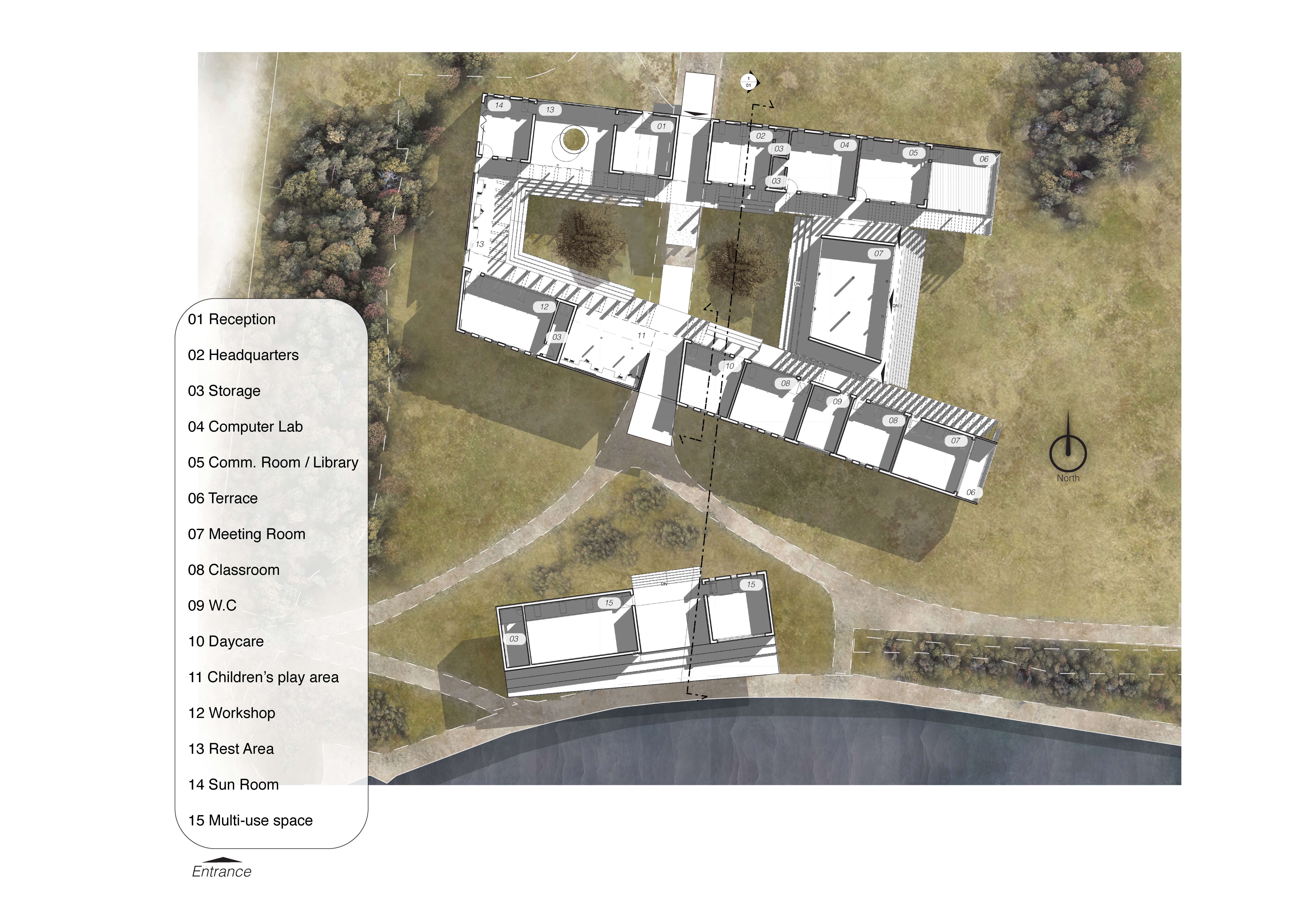
As the project lays on a park, the floor plan needed a strong connection with the exterior- offering all of the working spaces views either to the inner courtyards or of the park. There was also the difficult task of not closing up the building to the people on the outside of the program- this is one of the main reasons it was purposely set between one of the paths that lead directly to the canal; the entrance offers a permanent opening for pedestrian and cyclist alike, they ramp in and down into the courtyards as an inviting gesture to enjoy the spaces within the center or to move on along their day if that would be their choice. Another entry point is the cafeteria (07), because it has glazing on both facades it offers a transparent view into the building and through the courtyards, as well as having entry points on either side of the building that also welcome people to enjoy the center. A recurrent theme in the design, was the frame, emerging from the roof and landing on the platform to form and open corridor that offers a play of natural light against the weathered wood, that changes as the weather does. The frame also has more concentration on the more exposed eastern side, it provides more privacy without closing up the space.
The floor plan mainly consists of educational spaces, from the manual (12), to the theoretical (04,08). The objective is to prepare the community as well as possible in job and career training as well as other activities that will benefit them and the canal- the center also offers a daycare for parents who may not have the opportunity to leave their children with anybody else whilst they study. The carpentry workshop, is located farthest from the other spaces mainly because of noise and isolation from the particles that the area would produce. The space equips the interested community members with more manual skills if they were to desire to work in that field as well.
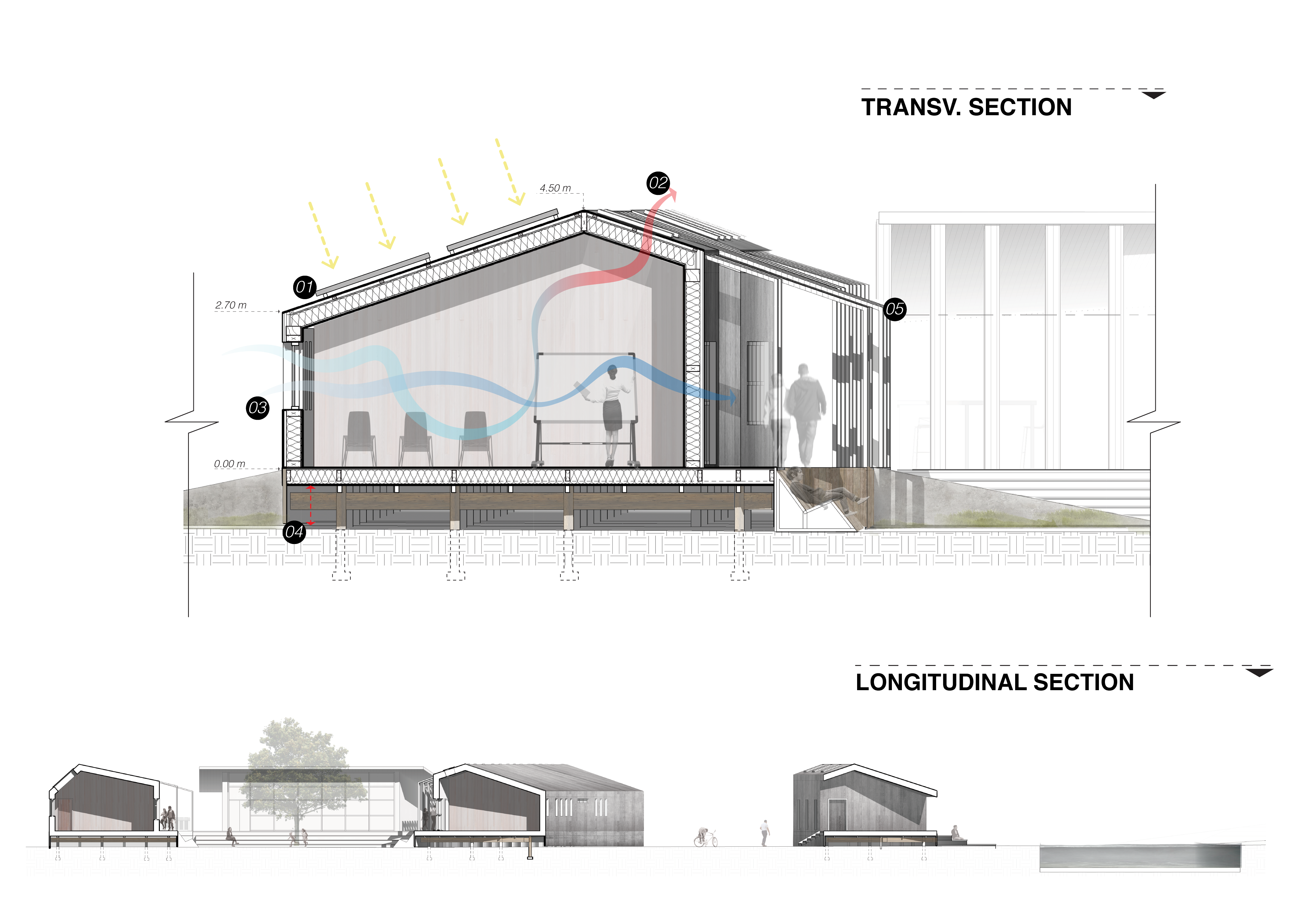
Sections : Environmental Strategy
 WATER LOGIC: REGENERATING UNION CANAL